Saturday, August 25, 2012

Kodak 66x 'Instamatic' Camera

One of the reasons I started a blog is so that I could post reviews on one of my favorite things: gadgets. For my first tech review, I feature ‘vintage tech’: my late father’s Kodak 66x ‘Instamatic’ Camera.

Specs:
- Produced between 1973-1977
- Lens : f/11
- Shutter 1/60
- Film type : 126 cartridge
- Picture size - 28mm x 28mm
 
This was prompted when one of my former students, Kimberly Daco, posted a picture of herself wearing retro clothing. But the big nerd that I am, I noticed what was hanging on her neck: a vintage camera.


 Photo courtesy of Kim Daco.
Kim, who is studying Mass Communication, told me that she and her classmates rented a manual camera for their photography course. I suddenly remembered the camera we would use to take pictures when I was small. After a short search, I found, still in its original leather case, my father’s old camera.


My father’s old camera is the Kodak 66x ‘Instamatic’ Camera. According to my research on the Interwebz, this model was made from 1973 to 1977. (According to my mother, my father bought this camera around the time my older brother was a little; so it fits the time frame.) The Instamatic series was a line of affordable cameras made by Kodak.

Here is the article from Wikipedia:


Here is a blog entry of a guy who is selling his Kodak 66x:


Our camera was made of lightweight but durable black plastic. On top was a slot where disposable flashbulbs were inserted. I remember when I was little when Papa would buy a box of flashbulbs. Each bulb had four sides. When a picture was shot, the slot would rotate the bulb for the next picture. How’s that for high tech!


On the top right of the back of the camera, was a plastic lever. This advanced the film and cocked the shutter. I tried it a few times, and to my surprise, the camera is still working!


I posted pictures of my father’s camera on the Internet and I was surprised that so many people liked it! Another former student, Nadine Destura, commented, perhaps with a hint of envy, that she finds vintage tech cool. Miss Jilliann Pagcaliwagan, a nurse who took care of my father during his last days, relates that one time she and my mother had a conversation about this camera. Of course, Kim was excited about this camera and asked if it still worked. It still works!


I really wanted to buy a roll of film and go around the campus snapping pictures on my father’s old camera. But my heart sank when I find out that the film size for this camera is 126, (not 135 as I expected). According to my research, this type of film ceased production in 2008 (that recent!) and many film developers would no longer process the film. Too bad!

Cameras were made to capture fleeting moments so that they would become permanent memories. As Optimus Prime said in the closing lines of Transformers: Revenge of the Fallen, “It is through these memories, we live on.” So here a few pictures of me and my late Papa, when I was little. (I posted one of these to commemorate my father on Father’s  Day.) 


  It is through these memories, he lives on.


To Whom Shall We Go?

John 6:59-69
13th Sunday after Pentecost (Kingdomtide) B, 2012


We are about to finish a series on Jesus' "Bread of Life" discourse in John 6. How does this all end?

I. "This is a hard saying" (v. 60)

The people were saying, "This is a hard saying; who can accept it?" (Literally, "hard saying" is Ī£ĪŗĪ»Ī·ĻĻŒĻ‚...Ī»ĻŒĪ³ĪæĻ‚ sklēros logos, a 'hard [or difficult] word' and "accept" is ακουειν, akouein, "hear".) The teaching of Jesus that he is "the Bread of Life" is a "hard word" or a "difficult teaching". For many people, Christian teaching is a "hard teaching". Now it is not because Christian doctrine is impossibly hard to understand; it's because people choose not to believe it. "The light shines in the darkness, but the darkness has not understood it" (John 1:5)

Yes, there are points of Christian doctrine which are hard to understand. For one, there are doctrines which are mysteries, like the mystery of the Holy Trinity. We do need to fully "explain away" these mysteries or "dumb down" Christian doctrine. A religion without mystery is a religion without wonder. But then there are other Christian teachings which are difficult to accept because they run against what we want. That is why we find it difficult to follow Jesus' teaching to love our enemies, pray for those who persecute us, and bless those who curse us. For us Protestants, it may be difficult to accept that we need to partake of Communion every Sunday because it ruins our style!

Now, to us, is the teaching of Jesus that he is "the Bread of Life" difficult to understand or difficult to accept? Do we accept that we need to frequently partake his Body and Blood so that we can abide in him, and he with us (6:56)?

There are two ways to accept a "hard teaching": to reject it or to believe in it.

II. Does this offend you? (v. 61)

Jesus said, "Does this offend you?" The word "offend" here is ĻƒĪŗĪ±Ī½Ī“Ī±Ī»ĪÆĪ¶Ļ‰ skandalidzō, literally meaning, 'to put a stumbling-block' or 'to cause to stumble'. Are we "scandalized" or "offended" by the teachings of Jesus? The teachings of Jesus are offensive because they run counter to our beliefs. Jesus said, "The Spirit gives life; the flesh accounts for nothing. The words I have spoken to you, they are spirit and they are life" (v. 67). "The mind of a person (literally, a "soulish/mind-ful" [read: self-opinionated, full of one's own ideas] person) cannot accept the things of the Spirit of God, for they are foolishness to him; and he cannot know it, because it is spiritually discerned" (I Corinthians 1:14).

The result is that many of his followers "turned back and no longer walked with (or followed) him" (v. 66). This has to be one of the saddest passages of Scripture. Why did they turn away from Jesus? Remember, they were looking for Jesus not because of the miracle he performed (the Feeding of the Five Thousand) but because they ate the loaves and were filled (6:26). They even wanted Jesus to give them bread everyday, just as Moses gave the Israelites manna everyday to eat in the desert (6:30-31). I can't help but thinking of those who believe in the "prosperity Gospel" who only believe because of promises of health or wealth. I can help but thinking of those who go to worship just because the music and the message entertains them. I can't help but thinking of those who use violent means but promise change in society and in the government. I can't help but thinking of those who just go to church because there is food, there are dole-outs. But when the food, the dole-outs, the fun are gone, they are also gone.

Jesus asked his disciples, and he asks us too: "Do you want to leave too?" (v. 67)

III. To whom shall we go? You have the words of eternal life (v. 68)

Simon Peter, in a moment of inspiration, answered, "Lord, to whom shall we go? You have the words of eternal life." Here, we can see the importance of Scripture in the life of the Christian. We remember when Jesus had fasted for forty days and forty nights, he was tempted by Satan: Turn these stones into bread! Jesus answered, "Man shall not live by bread alone, but from every word that proceeds out of the mouth of God" (Matthew 4:4). We do not live by bread, by material things alone; but we live by the Word of God. The Word of God is God is Spirit and life; it is the Word that gives eternal life.

But also Simon Peter said, "We believe and know that you are the Holy One of God" (v. 69). So the Christian does not concentrate on teaching alone, lest it just becomes head-knowledge. Many who call themselves "Christian" but take pride how much of the Bible they know. We must never forget the Teacher himself, who gave us his Body and Blood so that we may live. And this is why in The United Methodist Church, the church is where "the pure Word of God is preached, and the Sacraments duly administered according to Christ's ordinance..." (Articles of Religion, XIII).

To whom shall we go? To Jesus, who gave us his Word and his Body and Blood that we may have eternal life.

Friday, August 17, 2012

Real Food, Real Drink, Real Life!

12th Sunday after Pentecost (Kingdomtide) B 2012
John 6:51-58


In today's Gospel, Jesus continues his discourse of he being "the Bread of Life". Verse 51 has Jesus saying that he is "the living bread which came down from heaven". (The Tagalog Magandang Balita Bible [Good News Bible] translates this as "pagkaing nagbibigay-buhay", 'food that gives life' instead of "tinapay na buhĆ”y", 'living bread'.) The word "living" here is the Greek word ζάω zaō, related to ζωή zōē, meaning 'life'. The same word used in John 10:10, "I am come that they might have life, and that they might have it more abundantly." According to Thayer, this is "life real and genuine, a life active and vigorous, devoted to God, blessed, in the portion even in this world of those who put their trust in Christ, but after the resurrection to be consummated by new accessions (among them a more perfect body), and to last for ever." And by thsis "bread", Jesus means his flesh (and, by extension, also his blood--v. 53) which he will give for "the life of world".

I. The things of this world do not give this life. (v. 53)

Jesus said that the ancestors of the Israelites ate manna in the wilderness, and yet they died (v. 58; cf. v. 48). The things of this world are not eternal; therefore they cannot give us eternal life!

II. Jesus is real food and real drink that gives real life. (vv. 54)

A. How do we eat and drink of the Body and Blood of Christ (v. 52)? Here, Jesus is talking of Holy Communion, or the Eucharist (v. 53). It is through the Eucharist we eat and drink of the Body and Blood of Christ. Now, the Eucharist itself does not give eternal life, but it is Jesus himself, symbolized by the bread and cup, who gives us eternal life.

B. It is through Holy Communion that Jesus "abides in us", the same word that Jesus used in John 15:5 in the discourse of himself as the True Vine: "I am the vine, you are the branches: those who abide (μένω menō, 'to abide') in me, and I in him, bring forth much fruit: for without me you can do nothing." This why Jesus said, "Drink this, as often (oĻƒĪ¬ĪŗĪ¹Ļ‚ hosakis, a "multiple adverb") as you do this, in remembrance of me."

Addendum: Here is one of the sermons of John Wesley himself, entitled, "The Duty of Constant Communion" from the website of the UMC General Board of Discipleship. A downloadable PDF version is available here.

Breakfast at McDonald's Manggahan


It was an overcast early morning on the 15th of August,* 2012 when I left home and set on my mission: to eat breakfast.

I used to eat out for breakfast when I was teaching part time at a satellite campus of the university where I teach. Before classes I would eat out at Jollibee SM Marketmall (a.k.a. SM MOA, "Mall of Area", a jab at SM Mall of Asia) where my favorite breakfast is their corned beef  with fried egg and garlic rice. Or I would go to a 7-Eleven and get a microwaved tapsilog.

Then I was introduced to having breakfast at McDonald's by a former student student of mine, Jane Castandiello. (A bright, pretty girl with a kilometric name: I remember on the first day of class when her name wouldn't fit in my class record. I peered over my class record to look at the name’s owner. She would then transfer to another school but we stayed in touch through social networking. We would have a many interesting conversation on geek stuff.) She once posted on having a Sausage McMuffin with hash browns and hot chocolate for breakfast. Since I pass by McDonald's Manggahan every morning when I go to work, I decided to give it a go.

A sample of the crazy stuff we talk about.

I decided to get a "Big Breakfast" (since I'm a big guy) and this is what is what I got:


A sausage, scrambled eggs, two muffins, a hash brown, and a cup of hot  chocolate. I also got a free newspaper to boot. (The headline was about the burial of "Comedy King" Dolphy the previous day.)

I was surprised that the sausage was not hot dog-shaped but rather patty-shaped. I later looked up in Wikipedia (link here): lo and behold, there is such thing as a round sausage. So there I was, enjoying their tasty round sausage, reading the paper, browsing my phone, and watching people catch their ride to work or to school. Like a boss.

But this time, I decided to get sausage with garlic rice and scrambled eggs, hash browns and hot choco. (I wasn't given a newspaper this time.) It was rainy because of a southwest monsoon so I was wearing a jacket and brought along an umbrella. My kodachi-hilted umbrella can be seen in the background of this picture:


The sausage is hiding under the generous scrambled eggs.

Then I reached the state my friends and I call "Enlightenment", a state where one's stomach feels so full and one's head feels so light. Yes, food is my comfort.
 
*The Feast of the Dormition of the Theotokos according to the Orthodox tradition

Sunday, August 12, 2012

The Bread of Life - Coming to Faith


Here is the notes for my sermon this morning. I usually preach without a manuscript, but I study the readings the for the whole preceding week. So these notes were written after the fact.

In today's Gospel reading (August 12, 2012, Eleventh Sunday after Pentecost), we read a continuation of Jesus' discourse of himself being the Bread of Life (John 6:35, 41-51).

I. Lack of Faith: Unbelief (vv. 41-42).
Here, the people doubted that Jesus "came down from heaven" because they claimed to known his parents; thus "proving" that Jesus is really just human and not divine. Even today many believe that Jesus is not God but just human. Some people even claim that Jesus never existed; he is the product of religious imagination. Other may admit that a man named Jesus may have existed, but that's it; he has nothing to do with their lives. Unbelief can take many forms, whether theoretical or practical.

II. Coming to Faith: Belief (vv. 43-46)
Jesus answered that no one can come to him (that is, come to believe in him) except if the Father draws a person to Jesus. Jesus is also famously said that no one comes to the Father except through him (John 14:6). Jesus also said that it is the Holy Spirit who brings people unto him ("shall testify"; John 15:26).

Faith is not by any means a human act; as if it is accomplished solely by human means. Faith is not a human achievement; or else it would be classified as 'good works'. Faith is possible only by the grace of God. This is what is called by John Wesley as "preventing (now called 'prevenient') grace": By the grace of God that was made available even before we know God, we can come to faith.

(But this grace can be resisted: People come to not believe not because they were not given the grace to believe. It is because they resist the grace to believe [to "resist the Holy Spirit"; Acts 7:51].)

III. Result of Faith: Eternal Life (vv. 47-51)
The result of faith is eternal life. How is this possible? Jesus is unlike manna, physical food, which the ancient Israelites ate but nonetheless they died in the desert. Jesus, as he himself said, is the Bread of Life. By this he meant his flesh; i.e., the sacrifice of his Passion and Death on the Cross. And this sacrifice is commemorated in the Eucharist: "This is my Body which is given for you: Do this in remembrance of me" (Luke 22:19). ("Do this," not just "Remember me".) So Communion is not a ritual; it is a proclamation: For as often we partake of the Sacrament, we proclaim the Lord's Death until he comes (I Corinthians 11:26). Holy Communion is a Sacrament because it points us to the one who is the Bread of Life: Jesus Christ.

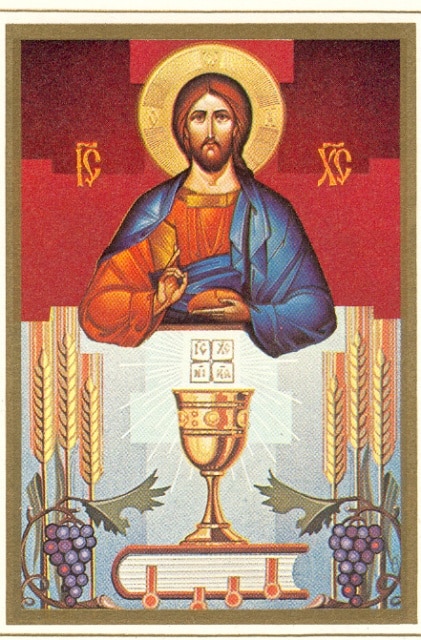
(Orthodox icon compliments of Ortho Cuban dot com.)

Wednesday, August 8, 2012

The Bread of Life - Word and Sacrament


For the whole month of August this year, the Gospel readings from the Revised Common Lectionary come from the sixth chapter of John, which tell of the miraculous Feeding of the Five Thousand (men, not yet counting the women and children, according to the Synoptic Gospels). In the RCL, the Gospel readings every Year "B" (2012 is such a year) comes from the Gospel of Mark. However, John 6 is inserted at the point where the readings from Mark comes to the Feeding of the Five Thousand. After an interlude of an account of Jesus walking over water, the chapter continues with a very long discourse of Jesus being "the Bread of Life". This is perhaps because the Gospel of John does not contain an account of the Institution of Holy Communion--instead it has the account of the Washing of the Feet. But one could notice the the obvious Eucharistic language in the sixth chapter of John.

I wish to quote part of a paper I wrote during my days as a seminarian studying Master of Divinity at Union Theological Seminary:
How is the bread of heaven understood by your church? The Protestant churches have a poor Eucharistic devotion. It is celebrated only once a month; in other churches, quarterly or even once a year! Often, it is treated as a postscript in the worship service. For Protestants, the “bread of life” is the sermon. Meanwhile, in the Catholic churches (plural), the climax of the worship service is NOT the sermon but the Eucharist.
Generally speaking, the climax of a Protestant (or evangelical, born-again, full-gospel' & c.) worship services is the sermon. Among Protestants, the expository preaching of Word, where a passage is studied verse-by-verse or section-by-section is held in high esteem. Another popular form of sermon is the topical method, where a topic, e.g., salvation or tithing, is explained by various passages from Scripture. In the Philippines, a typical Protestant sermon can last up to twenty minutes to an hour(!).

Meanwhile, the climax of the Catholic Mass is not the homily (in the Philippines, homilies generally last for five to ten minutes) but the Eucharist. It is truly impressive to watch the Eucharistic prayer where the priest conducts all the manual acts (lifting up the bread and cup, et c.). In high Masses, the Eucharistic Prayer (indeed, almost the whole service) is chanted--giving an atmosphere of solemn celebration.

Among Protestants, Holy Communion is often treated as an afterthought: it is tacked at the end of the service once a month. (In one "mall church", Communion was served the near the beginning of the service. The Communion wafers were balanced on top of the "shot glasses" of grape juice.) The pastor rattles off the words from the hymnal or launch on an extemporaneous prayer which may be a patische of Scripture, often without the Words of Institution. Also, some people appear to consider Communion as an inconvenience: it makes an already long service even longer.

Continuing with my paper,

The Church impoverishes itself when it tries to put one over the other. The Church is nurtured by BOTH the Word and Sacrament, just as Jesus “opened the Scriptures” and was “made known through the breaking of the bread” to the disciples at Emmaus (Luke 24:13-32). Just as there are two wings on a bird, or two feet and two hands on a person, so the Church needs both Word and Sacrament. As for the Protestant church, there needs to be an appreciation of the Eucharist not just as a “memorial” but as an anamnesis, a dynamic “re-presentation” of the mighty acts of God of God in Jesus Christ. It is not a simple recollection, but a dynamic remembering in the power of the Holy Spirit as such that it is “made real” to us today. Hence, the Eucharist is not a mere “reenactment” but an encounter with the real presence of Christ.

John Wesley believed in both the preaching of the Word AND the practice of frequent Communion. (A lengthy discussion on the teachings of Wesley on the Eucharist and the decline on its practice among Methodists may be in order here, but let's reserve that for another time.) It is by BOTH Word and Sacrament that the Body of Christ--the Church--is nurtured.

Suffice it to say now that the Lord has given the Church the means of nourishment. Not tidbits to snack upon, like scattered verses here and there. Not fastfoods that taste good but are nutritionally worthless,  just like the "pep-talks" which masquerade as "sermons". But full, three-course meal with the reading from the Bible followed by an exposition of the Word. Then there is the Eucharist, where the Risen Lord makes himself  known and imparts grace to us all. The Word and the Sacrament both point to the Bread of Life himself--Jesus Christ.

Monday, August 6, 2012

Rain, rain, go away...

I was supposed to write a sun-shiny piece on breakfast. But as of the moment, it has been raining for three weeks. Last July 21, Saturday, I woke up early and it was dark. I received a text from my student and friend, Chelsea, asking if classes have been suspended. I told her there is no announcement yet so she should attend her classes in the graduate school.

Little did I know that Typhoon Ferdie (a.k.a. international code name Vicente) would pour down rain comparable to that of a typhoon three years earlier. My poor friend. She had to brave the floods when classes were suspended and she had to go back home. And I was safely esconed at home.

On Monday, classes were suspended because of continuous rains. It was midterm week in our school so the students got an unexpected reprieve. On Tuesday, confusion reigned when conflicting news appeared on texting on social networking sites. It rained all day. And all week.

Then Typhoon Gener (a.k.a. Saola, named after a rare mammal in Vietnam), skirted eastern Luzon and sucked in the western monsoon, causing more rains.

It is raining now even as I type.

So I decided to write a short memoir on one of the worst typhoons to hit the country: Typhoon Ondoy, a.k.a. Ketsana.

September 26, 2009. I was supposed to attend my MA classes at Philippine Normal University, Manila. It had been raining. No sweat. So I wore my trusty pair of Wellington boots. Little did I know they would be of little use.

I arrived at school at around 7:00 am. Our professor, Dr. Gina Gonong, was not there. Then she called me on my phone saying that she will not be able to make it due to flooding along EspaƱa. (I heard that her car almost floated.)

Okay, so I thought. It’s just a usual typhoon. So I foolishly whiled away some time at school, hoping that the typhoon would blow over. I was wrong.

Then, some of my classmates and I decided to brave the winds, the rains, and the floods and to rush to the nearby SM City Manila. Our clothes were all soaked and we were all barefoot—we had to remove our footwear because of the floods. So were a lot of other people wet and barefoot. Our backs and feet were cold because of the airconditioning.

When I arrived at the exit towards the LRT Central Terminal, I got the surprise of my life.

The water had become so high. Workers were piling sandbags to keep the water from entering the mall and flooding the lower ground floor.

I took out my cell phone and took a video of what was happening.


ME: Ayan po, may barikada dito sa SM. Kita nyo po, ang daming taong stranded. (I pan the cmera to the side showing how deep and wide the water is.) At dagat na po ang kalye.(Then I pan my camera down to show that I am wearing galoshes.)

Okay, I thought. I just have to get to the Park and Ride so I can catch a bus home. The problem is how.

The only way was to ride one of those “pedicabs”—bicycles with sidecars attached—from SM to Central Terminal. The pedicab drivers were making a killing. It was forty pesos for the required distance…in waist- to chest-deep water! So passengers had to ride on top of the sidecars! I shared a cab with Maricris Valera, a deaconess in our church and also studying at PNU.

I was crazy enough to pull out my camera to get a reportage of the situation.


ME: Narito po kami ngayon sa SM! at napakatindi po ng baha!

MARICRIS: Namamangka po kami! Para kaming Titanic!

When we got to the Unibersidad de Manila, we parted ways. I had to remove my boots and hoist them and my bag over my head because the water was stomach-deep on the sidewalk. When I got to the Park and Ride, I and a lot of other passengers had to wait for more than an hour for a bus to arrive. I was wet, tired, and hungry.

At around 4 pm a bus arrived. It was promptly filled with passengers. I had to sit on the small fold-out chair beside the driver (which I think was supposed to be for the conductor).

I took out my camera phone again and recorded the first part of the journey out. The bus crew said they left Tagaytay at nine o’ clock in the morning. As the bus pulled out of the terminal, the full gravity of the situated appeared before us. What was supposed to be road became a sea.


ME (to the driver): Ngayon lang kaya nangyaring ganito?

The next video clearly shows how big the waves are caused by the bus. “Parang dagat!” a woman behind me remarked. I could have sworn the water almost reached the windshield.


Dry land is not a myth, I thought to myself. Manila has turned into a Waterworld.

It was relatively quick going to Manila to Baclaran. But when we crossed into Coastal Road, our ordeal began. Vehicles stretched as far as the eye could see. We were all wet, tired, irritated, hungry. Some people got the urge just to get off the buses and walk. I decided to stay put—at least the bus will protect me from the elements. At one point, like manna from heaven, a fish cracker vendor came aboard. That was my dinner. By this time, my phones had either run out of juice or shorted.

I arrived home at 3:00 in the morning, after eleven hours on the road. It was Sunday already.

I gave myself an hour of sleep and got up again. I had to go to church to conduct services to any of those present and to see how things were going. But going there is an adventure in itself. And that’s another story.


Postscript: Today is my birthday. It rained very hard last night and early morning so the authorities suspended classes once more. Coincidentally on the WB, the episode on The Big Bang Theory was on Leonard's birthday. This I enjoyed with a breakfast of Spam, fried egg and fried rice.